The Real Cost of Nitrogen in Laser Cutting: How to Reduce Gas Consumption and Improve Profitability

The Hidden Production Cost
For many laser cutting operations, nitrogen is viewed simply as an assist gas required to achieve clean, oxide-free cuts. While manufacturers closely monitor machine performance, material costs, and labor efficiency, nitrogen expenses often receive far less attention.
This can be a costly oversight.
A Critical Utility Often Overlooked
Nitrogen plays a fundamental role in delivering the cut quality required by industries such as automotive, metal fabrication, and precision manufacturing. It prevents oxidation, supports efficient processing, and reduces the need for downstream finishing operations.
Unlike a laser cutting machine, however, nitrogen is a recurring operating expense. Every part produced consumes gas, meaning costs increase directly with production output.
Because nitrogen expenses are often spread across supplier invoices and operating budgets, their true impact can remain difficult to quantify. As a result, many manufacturers underestimate how significantly gas consumption affects overall profitability.
Looking Beyond the Price of Nitrogen
Evaluating nitrogen supply based solely on the price per cubic meter provides only a partial picture.
The real financial impact is better understood through metrics such as:
- Cost per part
- Cost per shift
- Cost per machine hour
- Total annual nitrogen expenditure
Viewed through this lens, nitrogen becomes more than a consumable gas. It becomes a strategic production cost that directly influences margins and competitiveness.
Why Cost Visibility Matters
As manufacturers face increasing pressure to improve productivity while controlling costs, understanding nitrogen expenses is becoming increasingly important.
Companies that actively monitor and optimize nitrogen consumption are often better positioned to:
- Improve cost predictability
- Increase resource efficiency
- Strengthen long-term profitability
Rather than accepting nitrogen as a fixed operating cost, many businesses are now exploring ways to gain greater visibility and control over this critical resource.
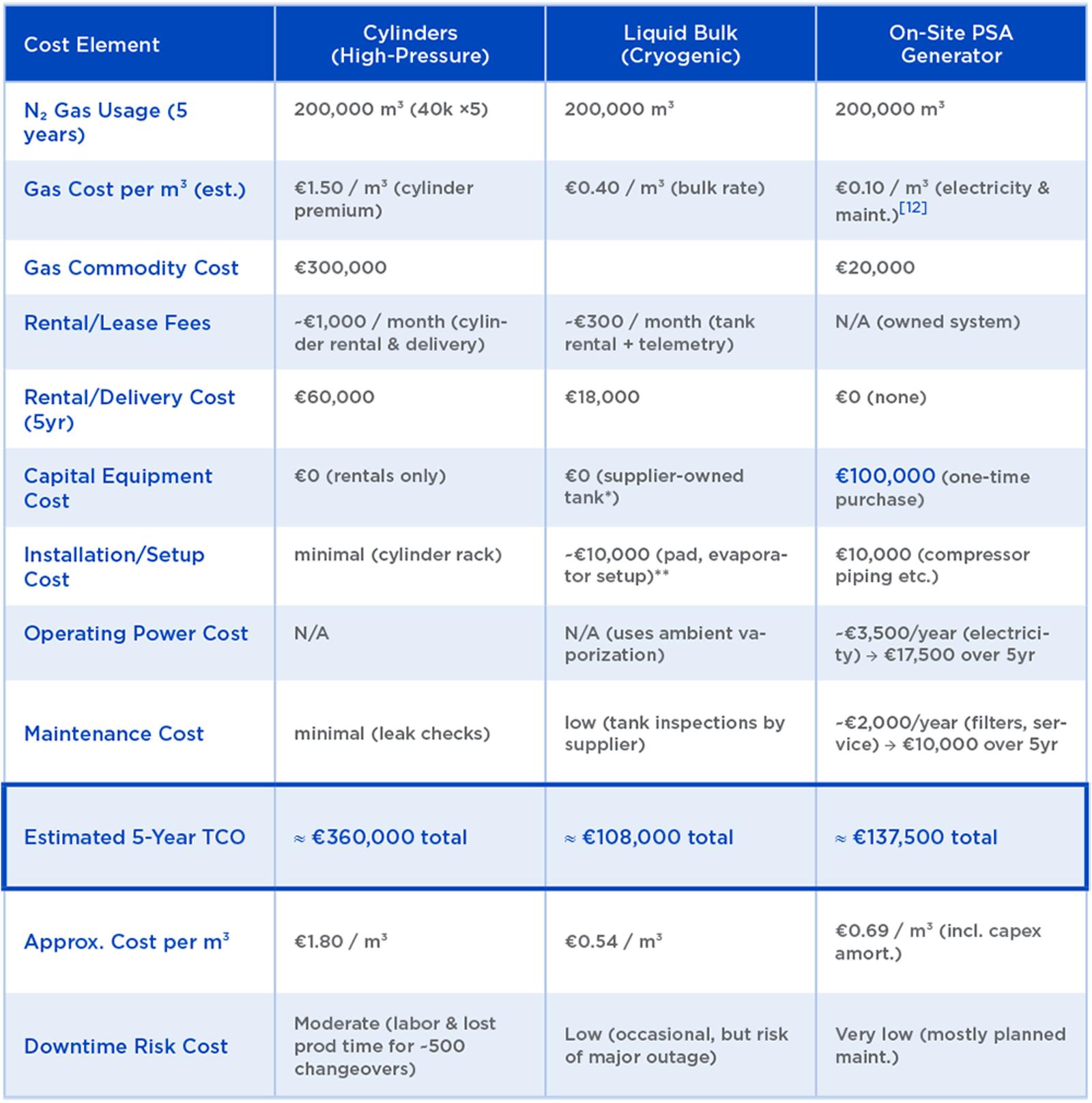
Laser Cutting Nitrogen Supply Cost Comparison: Example based on a mid-size fabrication shop operating one fiber laser and consuming approximately 40,000 m³ of nitrogen per year.
What Drives Nitrogen Consumption?
Understanding the true cost of nitrogen starts with understanding what drives consumption. While nitrogen is essential for achieving clean, oxide-free cuts, the volume required can vary significantly depending on production conditions.
Gas usage is influenced by a combination of technical and operational factors. Identifying these variables is the first step toward improving efficiency, controlling operating costs, and optimizing overall production performance.
Key Factors Influencing Nitrogen Consumption:
- Material thickness has a direct impact on nitrogen demand. Thicker materials generally require higher gas pressure and flow rates to efficiently remove molten material from the cutting zone. As thickness increases, nitrogen consumption often rises disproportionately, making gas costs a larger component of overall production expenses.
Cutting Parameters: Nitrogen consumption is heavily influenced by cutting settings such as pressure, nozzle configuration, and cutting speed. These parameters are closely interconnected, and adjustments made to improve cut quality can sometimes increase gas usage. Finding the right balance between performance and efficiency is essential.
Machine Utilization. A laser cutting system running continuously across multiple shifts will consume significantly more nitrogen than one operating only a few hours per day. Machine utilization directly affects gas demand and plays a key role in determining annual nitrogen costs.
Production Volume. As production output increases, so does nitrogen consumption. High-throughput operations require larger volumes of assist gas to maintain consistent cutting performance, making nitrogen management increasingly important as businesses scale.
Nesting Efficiency. Efficient nesting strategies help reduce cutting time and improve material utilization. Optimized cutting paths can lower overall nitrogen consumption while maintaining productivity, contributing to better cost control across the operation.
The Importance of Process Optimization
Many manufacturers view nitrogen consumption as a fixed requirement. In reality, there are often opportunities to improve efficiency without compromising cut quality.
By monitoring usage patterns and optimizing process parameters, companies can reduce unnecessary consumption while maintaining productivity and performance. The objective is not simply to use less nitrogen, but to ensure that every cubic meter contributes maximum value to the production process.
Understanding what drives consumption provides the foundation for evaluating supply strategies and identifying opportunities for long-term savings.
The Hidden Impact of Nitrogen Costs on Profitability
Nitrogen is often treated as a necessary operating expense in laser cutting. However, as production volumes increase, it can become one of the most significant recurring costs in the manufacturing process.
For many companies, the impact is not immediately visible because nitrogen costs are spread across production budgets and operating expenses. Yet when measured at the component level, gas consumption directly affects profitability.
Why Cost Per Part Matters
In competitive manufacturing environments, margins are often determined by small differences in production costs.
Every component carries a share of the total nitrogen expense. The more gas consumed during cutting, the greater the cost allocated to each finished part.
This is particularly relevant for manufacturers processing thicker materials, operating at higher pressures, or producing high volumes. In these environments, nitrogen costs can represent a significant contribution to overall production expenses.
Rather than focusing exclusively on gas price, leading manufacturers increasingly evaluate nitrogen performance through metrics such as cost per part, cost per machine hour, and total annual gas expenditure. These indicators provide a much clearer picture of how consumption affects profitability.
The Hidden Cost of Inefficiency
Nitrogen costs are influenced not only by consumption volume, but also by process efficiency.
When gas usage is higher than necessary, operating costs increase while profit margins gradually decline. Because production continues uninterrupted, these losses often remain hidden within broader manufacturing expenses. Over time, however, excessive nitrogen consumption can significantly affect competitiveness, especially in industries where margins are already under pressure.
As production volumes rise and machine utilisation increases, inefficiencies that may initially appear insignificant can quickly scale into substantial annual costs.
When Growth Increases Costs
Production growth typically drives higher revenue, but it also increases nitrogen demand.
Without effective monitoring and optimization, manufacturers may face:
- Rising operating costs as output increases
- Reduced profitability on high-volume jobs
- Greater exposure to fluctuations in nitrogen supply costs
Understanding the link between nitrogen consumption and profitability is therefore essential for sustainable growth.
Turning Visibility into Savings
The first step toward reducing nitrogen-related expenses is understanding where and how gas is consumed throughout the production process.
Manufacturers that actively monitor consumption patterns are better positioned to identify inefficiencies, improve resource utilization, and strengthen profitability. By gaining greater visibility into nitrogen costs, companies can make more informed decisions about both production optimization and supply strategy.
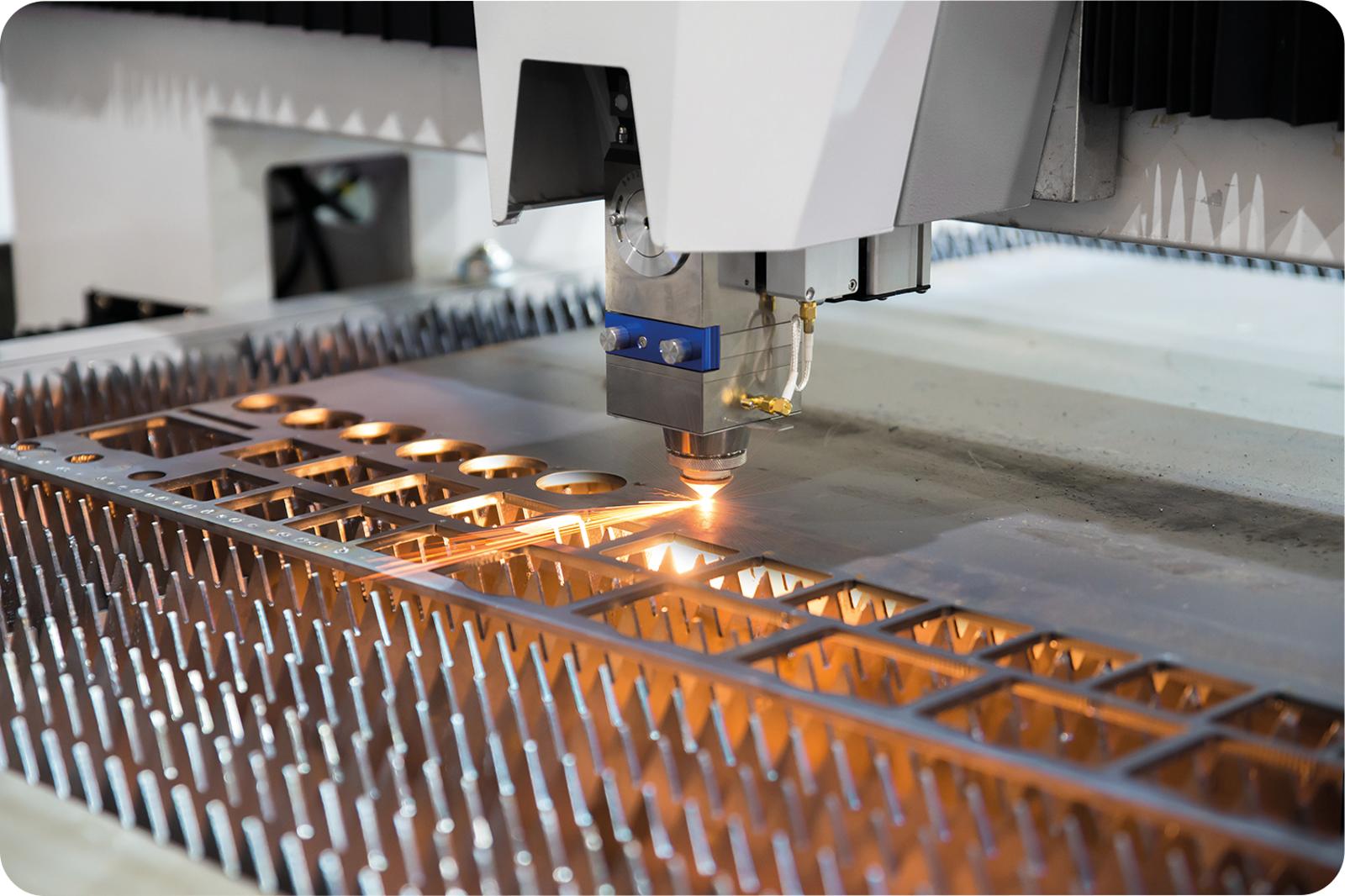
Bulk Nitrogen, Cylinders, or On-Site Generation: Comparing Supply Strategies
Once manufacturers understand how nitrogen consumption affects profitability, the next question becomes strategic: how should nitrogen be supplied?
The answer has a direct impact on operating costs, production continuity, and long-term competitiveness.
Understanding the Main Supply Models
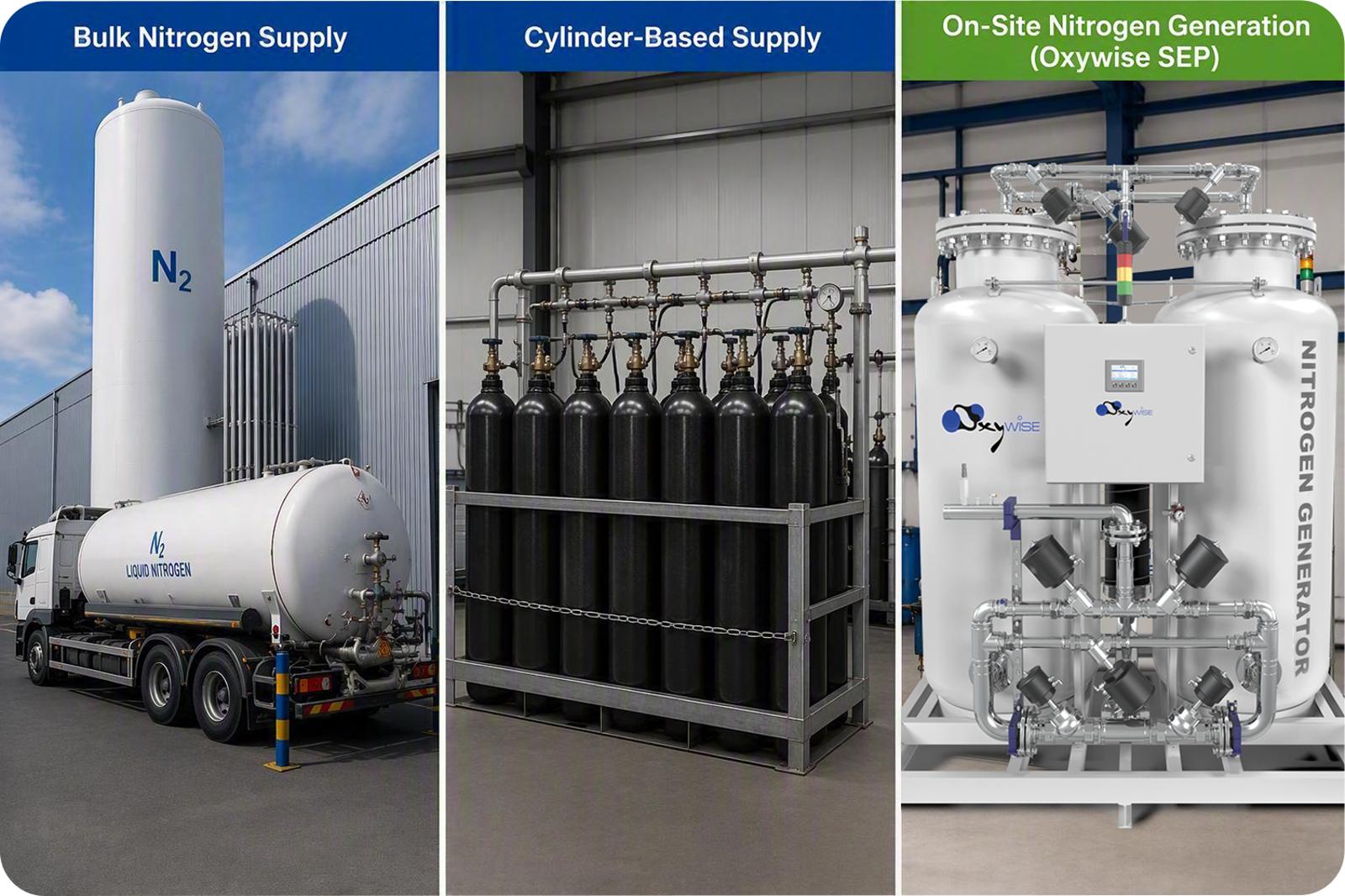
Most laser cutting operations rely on one of three supply methods: bulk liquid nitrogen, compressed gas cylinders, or on-site nitrogen generation.
Bulk nitrogen is commonly used in medium and high-volume operations because it supports continuous production. However, it requires storage infrastructure, regular deliveries, and ongoing supplier dependency.
Cylinder-based supply offers flexibility and relatively low upfront investment, making it suitable for smaller operations or backup applications. As production volumes increase, however, managing deliveries and replacements becomes more complex and costly.
On-site nitrogen generation follows a different model. Instead of purchasing nitrogen as a delivered commodity, manufacturers produce nitrogen directly at their facility, aligning supply more closely with actual production requirements.
Looking Beyond the Purchase Price
Comparing supply options based solely on the cost of nitrogen often provides an incomplete picture.
The true economic impact also includes factors such as storage infrastructure, logistics, maintenance requirements, and exposure to supply disruptions. These costs become increasingly important as production grows and gas consumption rises.
A delivered supply system may appear cost-effective initially, but recurring delivery fees and price fluctuations can significantly affect long-term operating expenses. Conversely, on-site generation typically involves a higher initial investment while offering greater predictability over time.
This is why many manufacturers evaluate nitrogen supply using a Total Cost of Ownership (TCO) perspective rather than focusing exclusively on gas price.
Reliability and Operational Independence
Reliability is equally important.
Laser cutting operations depend on consistent production schedules and customer delivery commitments. Any interruption in nitrogen availability can affect throughput and create bottlenecks across the manufacturing process.
For this reason, many companies are assessing supply strategies based not only on cost, but also on operational autonomy and resilience.
As production requirements evolve, maintaining a reliable and predictable nitrogen supply becomes a strategic advantage rather than simply a production necessity.
Ultimately, the best supply strategy depends on production volume, growth objectives, and cost priorities. Understanding the strengths and limitations of each approach is the first step toward making informed decisions that support both efficiency and profitability.
From Compressed Air to Laser-Grade Nitrogen
Clean, dry compressed air is transformed into laser-grade nitrogen and delivered at stable pressure, ensuring consistent cutting quality.

From Operating Expense to Competitive Advantage: The Case for On-Site Nitrogen Generation
As nitrogen costs become a more significant part of manufacturing expenses, many companies are looking beyond short-term supply decisions and evaluating how nitrogen fits into their broader production strategy.
What was once considered a necessary utility is increasingly being viewed as a strategic production resource with a direct impact on profitability and competitiveness.
From External Supply to Internal Control
Traditional supply models rely on continuous nitrogen purchases. Whether supplied through bulk tanks or cylinders, operating costs remain closely tied to production volume, supplier pricing, and delivery schedules.
On-site generation introduces a different approach. By producing nitrogen directly at the point of use, manufacturers gain greater visibility into consumption while aligning supply more closely with production demand.
This increased control can help reduce uncertainty and improve cost predictability across the operation.
The Value of a More Predictable Supply Strategy
Beyond reducing dependence on external suppliers, on-site generation can provide meaningful operational and financial advantages.
Key benefits often include:
- Lower and more predictable operating costs
- Reduced exposure to supply disruptions
- Improved production continuity
- Greater flexibility as capacity requirements evolve
These advantages become particularly relevant in high-volume production environments, where nitrogen represents a substantial share of recurring operating expenses.
Supporting Long-Term Profitability
Perhaps the greatest benefit of on-site generation is the ability to transform nitrogen management from a recurring expense into a controllable business variable.
When supply is available on demand and costs become more predictable, manufacturers gain greater flexibility to optimize production without constantly balancing performance against gas expenditure.
As a result, nitrogen can evolve from a cost center into a competitive advantage, supporting productivity, protecting margins, and enabling sustainable growth.
Key Takeaways for Manufacturers
Nitrogen plays a far greater role in laser cutting operations than many manufacturers realize. While often viewed as a necessary production utility, its impact extends directly to operating costs, profitability, and production efficiency.
From gas consumption and cost per part to supply reliability and long-term competitiveness, the way nitrogen is managed can influence both day-to-day operations and overall business performance. As production volumes increase and margins come under greater pressure, understanding these relationships becomes increasingly important.
Manufacturers that gain visibility into nitrogen consumption and evaluate their supply strategy more strategically are often better positioned to improve cost control, strengthen operational resilience, and support sustainable growth.
By treating nitrogen as a manageable production resource, rather than simply an unavoidable expense, companies can unlock opportunities to improve both efficiency and profitability.
Start Reducing Nitrogen Costs Today
Every laser cutting operation is different, but the challenge is often the same: balancing productivity, quality, and operating costs.
Understanding how nitrogen consumption influences your production economics is the first step toward identifying opportunities for improvement.
Download the white paper to explore how manufacturers are rethinking nitrogen supply strategies to improve efficiency, increase cost control, and support long-term operational performance.